

Lockout Tagout (LOTO) in Canada: Complete Guide to Compliance, Padlock Selection & Program Setup
Updated: Aug 17

If you’re researching lockout tagout requirements, building a LOTO program, or trying to stay compliant with Canadian safety regulations, this guide covers everything you need—clearly and practically.
From how many locks you need to which padlocks to choose, this is a complete, SEO-optimized resource for facility managers, contractors, municipalities, and safety professionals across Canada.
What is a Lockout Tagout Program?
A Lockout Tagout (LOTO) program is a safety system designed to ensure that machinery and equipment are:
Properly shut down
Isolated from all energy sources
Locked so they cannot be restarted
LOTO protects workers from hazardous energy such as:
Electrical
Mechanical movement
Hydraulic pressure
Pneumatic systems
Stored or residual energy
Why Lockout Tagout is Required in Canada
Across Canada, LOTO is a legal requirement under provincial occupational health and safety regulations.
While each province has its own legislation, all require:
Energy isolation before work begins
Personal lock control (one worker, one lock)
Training and written procedures
Verification of zero energy state
Failure to comply can result in:
Serious injury or fatalities
Fines and enforcement orders
Project shutdowns
Common LOTO Questions
How many locks are required for a lockout program?
Minimum:
1 lock per authorized worker
Best practice (recommended):
10 locks per employee
This allows:
Multiple lockout points
Efficient maintenance workflows
Backup availability
Can multiple workers share a lock?
No. Canadian standards require:
Each worker must apply their own lock
Locks must be uniquely keyed
Only the worker who applied the lock can remove it
What types of locks are used for LOTO?
LOTO requires dedicated safety padlocks, not standard hardware store locks.
These locks must be:
Durable
Tamper-resistant
Clearly identifiable
Controlled under a strict key system
Best Padlocks for Lockout Tagout Programs
Choosing the right padlock is critical for both safety and compliance.
General Lockout Applications
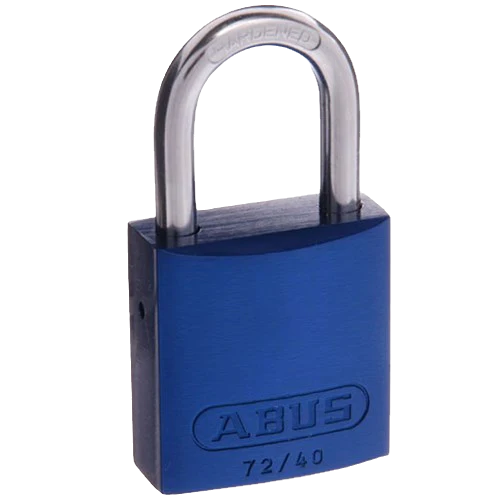
The ABUS 72IB/40 is one of the most widely used padlocks for LOTO programs.
Why it’s ideal:
Corrosion-resistant aluminum body
Hardened steel shackle
Compact design for tight spaces
High-quality cylinder for key control
Available in multiple colors for worker identification
Best used for:
Mechanical equipment
Valves and machinery
Indoor and outdoor environments
Electrical Lockout Applications

For electrical work, the ABUS 74/40 is the preferred solution.
Key advantage:
Fully non-conductive body and shackle
Why it matters:
Eliminates risk of electrical conductivity
Improves worker safety in energized environments
Best used for:
Electrical panels
Breakers
High-risk electrical isolation points
Lockout Tagout Keying: The Most Overlooked Requirement
One of the biggest compliance risks in LOTO programs is poor key control.
What’s required:
Each worker must have exclusive key access
No duplicate keys across employees
Locks must not be interchangeable
The Simplest Way to Stay Compliant
A proven approach used across Canada:
Purchase 10-lock packs per employee
Through Lockcetera:
Each employee receives 10 padlocks
Each pack is:
Keyed alike (one key per worker)
Keyed different from every other pack
Benefits:
Eliminates accidental key overlap
Simplifies inventory and management
Speeds up lockout procedures
Meets compliance expectations
Provincial Differences in LOTO Requirements
Although similar, each province enforces LOTO slightly differently.
Ontario
Requires full energy isolation and lockout procedures
Strong emphasis on training and enforcement
Alberta
Requires verification of zero energy state
Alternative methods allowed only if lockout is not possible
British Columbia
Requires documented lockout procedures
Strong regulatory oversight
Quebec
Strict “cadenassage” requirements
One of the most rigorous enforcement environments
Other Provinces
Follow similar frameworks:
Personal locks
Written procedures
Worker training
LOTO Equipment Checklist
A complete lockout tagout program includes:
Safety padlocks
Lockout hasps
Breaker lockouts
Valve lockouts
Group lock boxes
Warning tags and labels
Lockout Tagout Best Practices
To build an effective and compliant program:
Standardize on high-quality locks
Assign locks per employee (not shared)
Use 10 locks per worker as a baseline
Implement strict key tracking
Train staff regularly
Audit your LOTO procedures annually
Final Thoughts: Building a Safer, Compliant LOTO Program
Whether you’re starting a lockout program or upgrading an existing one, success comes down to:
Proper procedures
Correct number of locks
High-quality hardware
Strong key control
Using proven solutions like:
ABUS 72IB/40 for general applications
ABUS 74/40 for electrical safety
…and sourcing structured lock packs through Lockcetera ensures your program is:
Safer
Easier to manage
Fully compliant across Canada



Comments